Category Archives: POFF 2025

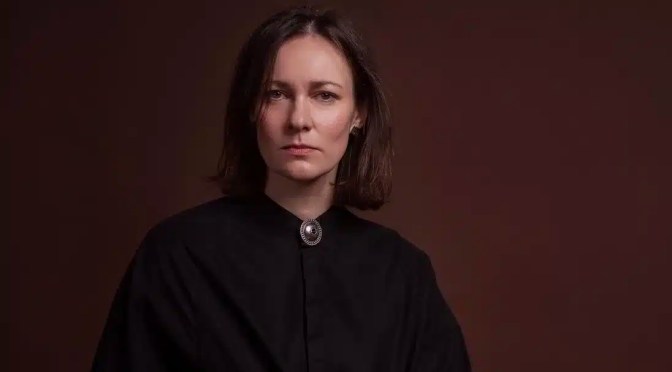
Tallinn 2025 interview: Golshifteh Farahani – The Dragon Within

When Golshifteh Farahani walks into a room, she carries with her more than fame. She carries the weight of an entire cinematic tradition, the still-burning fire of exile, and the quiet strength of a woman who has rebuilt herself in multiple countries, languages, and artistic worlds. PÖFF has welcomed its share of icons, but this year one of the brightest presences belonged to a woman in her forties — luminous, restless, and utterly alive.

Farahani remains one of world cinema’s most compelling figures — a performer shaped by exile, sharpened by experience, and sustained by an unyielding artistic hunger. In Oh, What Happy Days! she delivers a performance born from instinct rather than preparation, chaos rather than control — a rare reminder of what cinema can reveal when the actor steps aside and something deeper speaks through them.

Below is a conversation between Farahani and Milani Perera at the 29th Tallinn Black Nights Film Festival — an intimate drift across memory, identity, exile, and the unpredictable alchemy of performance.

MP: This is your first visit to Tallinn, despite many invitations over the years. How did it feel coming to the festival at last?

GF: It felt like finally arriving in a place I was meant to visit years ago. I’ve been invited many times, but filmmaking always intervened. Being here now, walking through the festival atmosphere, feels like meeting a memory I never lived — something familiar yet completely new.

MP: Your upbringing was deeply artistic — a home of painters, actors, writers, musicians. How did this constellation shape the performer you became?

GF: In my family, art was not a profession. It was a way of existing. Being an artist was the highest expression of being human. Yet acting was the one thing they tried to protect me from. They knew its sacrifices, its uncertainties, and in Iran, its dangers. I was trained as a pianist and nearly moved to Vienna. But cinema found me early — when I was fourteen — and something irreversible happened. From that point on, film became my second language.

MP: Your first major award came at 14 — a historic moment. How did that recognition echo within your family?

GF: My parents were furious while I was shooting that film. My father wasn’t speaking to me; my mother was crying, convinced I would abandon music. But the night of the award changed everything. I remember Tehran covered in snow, my father and me running across a bridge toward the Opera House. For the first time, I saw pride break through his resistance. It was as if that moment revealed a truth to both of us — that cinema had claimed me, whether we had planned it or not.

MP: There’s a long-standing debate among cinephiles: do actors choose their roles, or do roles choose them? Where do you stand?

GF: I think it’s a dialogue between the two. When you look across an actor’s career, you often see a gravitational pull — certain themes that keep returning, as if the universe is handing them back in new forms. For me, after leaving Iran, I found myself drawn toward characters in states of emancipation, transformation, defiance. Later I stepped into warrior figures — women in combat, both literal and metaphorical. Now… I feel life pushing me toward comedy, toward a lighter rebellion. Perhaps that is the current the universe is sending back to me.

MP: You’ve spoken openly about your exile. For many artists, exile becomes both a wound and a studio. What did it become for you?

GF: Exile became a limb I lost — and a limb I learned to live without. When Ridley Scott cast me, sanctions stopped the contract, and suddenly I became a political suspect. My passport was taken. Interrogations, uncertainty, fear — it lasted months. Eventually I left. And exile… Exile is an invisible scar that becomes part of your identity. You become a handicapped soul — but handicapped souls can still become champions. Eighteen years later, I feel strangely at home everywhere. Perhaps that is the final shape of exile — to belong to the world as opposed to one place.

MP: Your new film Oh, What Happy Days! brought together actors from inside Iran and actors in exile — something nearly impossible. What drew you to this project?

GF: It felt like a call I couldn’t refuse. To stand on the same screen with compatriots inside Iran — after so many years away — was a gift. I didn’t even finish the script before filming. I was discovering the story as the camera rolled. At one point, something wild erupted — a dragon; a range of emotions I didn’t anticipate: laughter, rage, chaos, release. I struck the table so hard I injured my hands. But it felt honest, instinctive, necessary — like a truth coming out of hiding.

MP: Was this experience shaped by your collaboration with director Homayoun Ghanizadeh?

GF: Absolutely. Homayoun builds spaces that disarm the actor — spaces where ego, preparation, and control fall away. He wanted presence, not performance. Because of that, I could react without thinking, feel without shaping, fall without fear. He created the platform, and the dragon walked out.

MP: As programmers, we were struck by the film’s formal disorientation — its chaotic conversations, tonal fractures, sudden shifts. Yet that dissonance becomes the point. Do you see this as a step toward comedy for you?

GF: Comedy has always existed on the edge of tragedy. Perhaps after years of playing women in battle, it is time to laugh — not in dismissal, but in defiance. Sometimes laughter is the last honest weapon. If this film is a doorway into comedic work, I’m ready.

MP: Golshifteh, thank you for this conversation — and for the rawness and clarity you bring to cinema. Tallinn already feels different with you in it.

GF: Thank you. I feel the butterflies — and now I must run to the press conference!

As she rushed toward the waiting press conference, the energy she left in the room lingered: the sense that some artists do not merely act in films — they live entire histories within them.

(c) Photo copyright: Liis Reimann 

Originally appeared in The International Cinephile Society
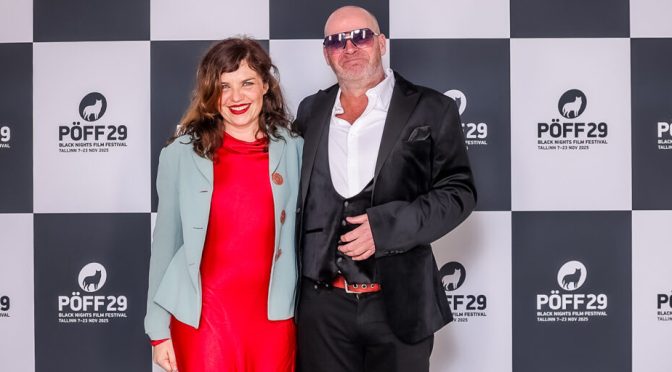
Tallinn 2025 interview: Richard Hawkins & Sarah Cunningham

On a quiet Tallinn afternoon, just hours after the world premiere of Think of England at the 29th Tallinn Black Nights Festival, I sat down with director Richard Hawkins and cinematographer Sarah Cunningham — a duo whose working chemistry is as vivid as the cinematic worlds they construct. The conversation unfolded like the film itself: brave, playful, and delightfully unpredictable.

MP: Before we get to the premiere, Richard — how do you see yourself as a filmmaker, and as an individual?

RH: Honestly? Badly defined. But the truth is simpler: I’m an adventurer. As a person and as a filmmaker, I love adventures. I don’t think I can say it any better than that.

SC: And that’s not just talk. One of the first things Richard told me was, “Be brave.” Every morning, he reminded me — if there are two choices, take the brave one. That set the tone for everything we did.

MP: Sarah, what is it like to work with a director whose instinct is to “be brave”? How did that shape your own identity as a cinematographer?

SC: It was liberating — and energising. Filmmaking is full of pressure: money, time, a big machine around you constantly asking, “Are you sure?” Richard protected a space where instinct mattered more than fear. I’ve always had an adventurer’s core — moving to unfamiliar countries, throwing myself into unknown environments — but as a cinematographer, especially as a woman, you’re often expected to be the safe pair of hands. Working with Richard allowed that adventurousness to come forward again. It wasn’t him “giving” me freedom — it was a collaboration, a shared authorship. We built the film’s grammar together.

MP: Richard, you mentioned bravery. On set, what does bravery look like in practice?

RH: The default instinct in filmmaking is to defend. You think you’re there to protect money, time, and reputation. But real filmmaking is the opposite — you must attack. You have to stay on the offensive creatively. And that is exhausting, but that’s where the life of the film is.

MP: Let’s talk about your working relationship. How would you describe the director–cinematographer partnership on this film?

RH: A director may pretend his closest relationship is with the actors. But in truth, the closest relationship is with the cinematographer. It’s a double act — like tennis doubles. If the communication breaks, everything collapses.

SC: We met first thing in the morning, last thing at night. It really did feel like a battle at times — but the kind where your ally is right beside you, matching your energy. That connection kept the film alive.

MP: How did your creative process begin? How did you build the film’s visual language together?

SC: Funnily enough, we discovered we live seventeen minutes apart in rural England. We’d sit with pencil and paper, sketching camera plans. Watch a clip from a 1940s film. Take a walk. Return to the table, re-draw everything. Eat iced buns. Then repeat. It was wonderfully old-school — and it allowed the visual language to emerge through conversation rather than prescription.

RH: Exactly. None of this was about executing a predetermined plan. We didn’t know exactly where we’d end up. That uncertainty was part of the design.

MP: The film shifts between stiff, classical black-and-white and intimate handheld sequences in colour. Why did you choose this dual grammar?

SC: From the start, we held the option to “jump the line” — to cross from the technicians’ perspective into the actors’ inner world. When we crossed it, everything changed: the camera’s rhythm, its grammar, its emotional texture. In black and white, we used the formal stiffness of 1940s cinema. In colour, we leaned into handheld vulnerability.

RH: It’s everything film school tells you not to do. Hard cuts between aesthetic worlds. Sudden emotional displacement. It feels “incorrect.” But that jarring leap is the emotional truth of the moment.

MP: Sarah, the 1940s aesthetic is unusually authentic. Tell me about the lighting choices.

SC: I limited myself to only direct lighting — no soft lights. Cinematographers in the 1940s worked with tungsten lamps and shadows, not infinite correction tools. Modern cinematography fears shadows, but shadows give images depth. So I embraced them — front lighting, direct lighting, sculptural lighting. It was radical, restrictive, and incredibly exciting. I wanted to work with the bravery of that era, not recreate it politely.

RH: What Sarah created is a true homage — not nostalgia, not imitation, but a reinvention of that period grammar.

MP: Editing such a film must have been a battlefield. What happened in the edit suite?

RH: Our editor is brilliant — and horrified. A lot of our material simply didn’t fit his trained sense of “correct editing.” Entire sections he initially removed were, for us, essential. So the edit became a negotiation: his conventional logic versus our deliberate anarchy.

SC: Editors guard comprehension, but life is full of things we don’t fully comprehend. Some mystery, some disorientation — that’s where cinema breathes.

MP: Now, Richard — why this story? Where is your journey in this film?

RH: I was drawn to the idea of collective identity — people who paused their former lives and became something else temporarily. COVID made me think about that: how we all gave up our previous selves for a strange suspended moment. The war was similar. These characters all come from previous lives put on hold. So the film became a collective story, not a personal one.

MP: And what finally convinces you — both of you — that the film’s bravery holds together?

RH: Being lost is part of any adventure that matters. If everything is safe and predictable, you may as well take the bus.

SC: Exposure is where the art is. Once you strip away modern armour — the soft lights, the safe choices — you’re vulnerable. But that vulnerability is exactly what makes the film breathe.

Think of England emerges as a work of bravery, dualities, risk, and deep creative kinship — a film born from instinctive trust, formal disruption, and a shared commitment to stepping across cinematic lines. It is, in every sense, an adventure — one undertaken together.

Originally appeared in The International Cinephile Society.

(c) Image copyright: Erlend Štaub

Tallinn 2025 interview: Eeva Mägi (Mo Papa)

Before the winners of the 29th Tallinn Black Nights Film Festival were announced, I spoke with filmmaker Eeva Mägi, whose Mo Papa would later receive a Special Jury Mention. Even without knowing the result, it was clear her film came from a place beyond craft — a place of intuition, emotional instinct, and an almost bodily understanding of storytelling.

Mägi works with fragments, impulses, and sensations rather than strict design. She speaks of filmmaking as a shared emotional current, shaped in deep collaboration with her actor Jarmo Reha and her DoP Sten-Johan Lill, and guided by the mythic frameworks of Joseph Campbell. The result is cinema that feels lived rather than constructed — a film that breathes.

What follows is a conversation where Mägi’s reflections deepen the quiet emotional power of Mo Papa.

MP: Let’s begin with Mo Papa. What moved you to tell a story this personal, this emotionally exposed?

EM: I didn’t aim for bravery — just honesty. Some stories grow so insistently inside you that eventually they need form. Mo Papa came from fragments: emotions, gestures, memories that wouldn’t rest. When something shapes you deeply, you try to understand it — and cinema becomes the safest distance from which to do that. It allowed me to look without flinching.

MP: Your filmmaking is known for its observational sensitivity. How did your documentary background shape this film?

EM: The documentary teaches you how to listen — not superficially, but with full attention. It trains you to notice the breath before the sentence, the tension in a room, the weight of a silence. When I moved into fiction, I carried that training with me. I didn’t want to polish reality — I wanted to honour it. Mo Papa is fiction, yes, but made with a documentary heart: patient, attentive, open to the unexpected.

MP: You’ve spoken about intuition being central to your process. How did intuition guide this film?

EM: Intuition led everything. I don’t begin with structure or theory — I begin with a feeling in my body. Something precognitive. I sense the rhythm before I know the story. With Mo Papa, intuition guided me to the moments that mattered: where to hold a shot, when to move, when to withdraw. And my collaborators trusted that instinctual drive. That trust was essential.

MP: Your collaboration with the actor and cinematographer feels particularly intimate on screen. How did you build that dynamic?

EM: We created an environment where vulnerability was safe. The actors weren’t performing; they were allowing themselves to be seen. And the DoP wasn’t merely capturing an image — she was entering the emotional space with them. We followed each other’s impulses. Sometimes the camera moved because the actor’s breath shifted. Sometimes an actor reacted because the camera lingered. It was a loop of presence and responsiveness. That is why the film breathes — because we were breathing together.

MP: Your films often explore bodily memory, grief, and the weight of unspoken emotion. Do you see Mo Papa as a continuation of these themes?

EM: Yes. All my films ask the same question: what do we carry without knowing it? Trauma, love, silence — they settle into the body. In earlier works, I approached these themes through form, through hybrid techniques. With Mo Papa I came closer to the source. It is more direct, more exposed, but still driven by the same pulse.

MP: How do you navigate working with such personal material while maintaining artistic distance?

EM: By remembering that film is not therapy. It’s art. The emotions are real, but the moment they become cinema, they belong to something larger than myself. I shape them, but I don’t unload them. That distance prevents the work from becoming self-serving. Cinema needs generosity, not confession.

MP: You mentioned being inspired by Joseph Campbell. How did his ideas inform your creative process?

EM: Campbell helped me understand that personal stories can hold archetypal weight. That what feels intimate can resonate universally. When I was shaping the film, his ideas reminded me to follow the emotional truth rather than a narrative formula. The mythic structure wasn’t a blueprint — it was a reminder that our private wounds often mirror collective ones.

MP: Tallinn feels like an emotional landscape in the film, not just a backdrop. How do you see the city?

EM: Tallinn is layered — historically, emotionally. I filmed it the way I experience it: comforting one moment, wounding the next. Not the postcard version, but the lived one. In Mo Papa, the city becomes another presence in the family — holding what the characters cannot say.

MP: And after Mo Papa, where is your intuition leading you next?

EM: To two projects: Mo Amor and Mo HuntMo Amor continues the emotional movement of Mo Papa — not as a sequel, but as another chapter in exploring identity, love, and the echoes of self. Mo Hunt goes deeper into darkness: a ballerina, a surrogate, a man in a crisis of faith. It’s psychological, visceral. Both projects scare me in different ways. And that’s why I need to make them.

Speaking with Eeva Mägi reveals a filmmaker who trusts her instincts more than convention, who builds cinema from breath, silence, and emotional presence. Mo Papa may have received its Special Jury Mention after this interview, but its power was already evident — a film assembled from fragments of truth, shaped through intuitive collaboration, and grounded in a rare emotional intelligence.

First Appeared in the International Cinephile Society

photo credit Sohvi Viik- Kalluste

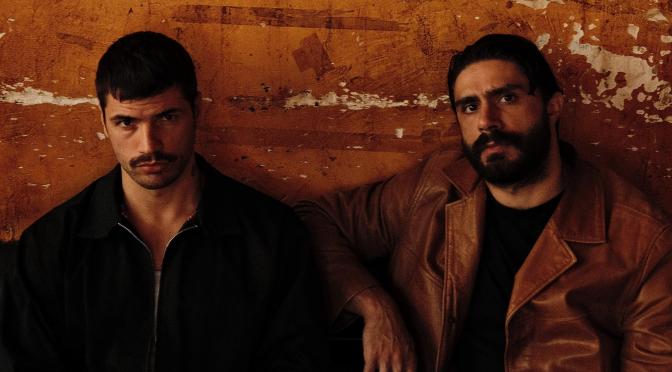
Tallinn 2025 interview: Hugo Diego Garcia & Lorenzo Bentivoglio (Vache Folle)

Milani Perera sat down with Hugo Diego Garcia and Lorenzo Bentivoglio at the 29th Tallinn Black Nights Film Festival, where their debut feature premiered in the festival’s “Rebels With a Cause” section. Only a few hours after that world premiere, Vache Folle travelled across the ocean for its Latin American premiere at the Mar del Plata International Film Festival, where it went on to win both the Astor Piazzolla Award for Best Actor and the Astor Piazzolla Special Jury Award — a remarkable feat for two self-taught outsiders who built their film from scratch.

What follows is a conversation with two debut directors who entered filmmaking not through institutions or permission, but through necessity. Hugo and Lorenzo are the kind of underdog artists who turn rejection into propulsion — filmmakers who rely on instinct rather than formal training, and who refuse to let industry walls define the scope of their imagination. Hugo and Lorenzo are not simply debut filmmakers; they are architects of their own cinematic language. With Vache Folle, they’ve announced themselves — loudly, defiantly — as rebels who refuse to wait for permission. The world is now watching. And they are just getting started. In this conversation, they revisit the beginnings of their creative partnership, the self-forged process behind the film, the making of their visceral protagonist Cédric, and what lies ahead for their cinematic universe.

MP: What first stirred the desire to become storytellers?

HG: Storytelling wasn’t a dream — it was refuge. I grew up in a village where filmmaking didn’t exist. My parents were in business and human resources. Cinema belonged to another universe. My brother and I watched films obsessively; we performed scenes, I drew manga. But we never imagined it as a profession. Later, I studied law, boxed, and tried my hand at theatre. Nothing aligned. The world kept saying “no,” so I learned to say “yes” to myself.

LB: I was like a child possessed by imagination — copying movies, reenacting battles. School wasn’t for me, acting school even less. I understood early on that I learn through experience, simply by doing something. So I filmed, I failed, I knew. Meeting Hugo sealed it — we recognised the same hunger.

MP: Without film school, how did you build your craft?

LB: Curiosity and survival. We shot scenes on cheap cameras. Edited for months. Devoured films. Observed people. Mistake after mistake — until the mistakes became style.

HG: When you have no money, you replace resources with instinct. We learned cinematography because no one else could shoot. We learned editing because no one else could cut. Everything we failed at became something we understood deeply.

MP: How did your partnership evolve into co-directing?

HG: I cast Lorenzo in a short about my father’s life. He wasn’t just acting — he was shaping the film. He saw angles that I didn’t. By the second short, he was doing cinematography and co-creating scenes with me. So when Vache Folle came, it was obvious — we should merge visions.

LB: Hugo is the origin and architecture. I am instinct and motion. I direct through emotion — through feeling the pulse of a scene. Together, we form the same heartbeat.

MP: How did you create Cédric — this beaten, tender, violent anti-hero?

HG: He’s a displaced version of me. Same age, same landscape, but pushed down harder by life. I borrowed my own mistakes and turned the volume up. We wanted a character shaped by love and violence at once — a poetic Rambo in a French realist world.

LB: I know Hugo. Working with him is like directing the part of myself I never speak about. Cédric came from that fusion — two emotional worlds merging into one man. He’s fragile and dangerous, innocent and flawed. He’s us.

MP: Why did you choose to make him a former soldier abandoned by the state?

HG: Because it’s a universal wound. A soldier is trained to serve — and then discarded. It’s not politics, but humanity. Someone built for intensity but returned to a world where intensity has no place. Narrative-wise, it creates stakes: trauma, competence, danger. Artistically, it anchors him in a tragic paradox.

LB: He’s a guy trying his best — but society moves too fast. He becomes a criminal because there’s no other road left open. That’s the real tragedy.

MP: Take me into the creation of the film. How did Vache Folle begin?

HG: COVID, a breakup, and no money. I moved from LA back to a mountain cabin with Lorenzo, my brother Malo, and our friend David. We trained like boxers during the day, created like possessed artists at night. I wrote the script fast — a month of pure emotion. One night, I asked: “Shall we make a feature?“, and they all said yes; the next morning, we bought a camera. That was our film school.

LB: We had nothing but desire. Out-of-focus frames, wrong lenses — we corrected, improved, and refined. We grew as the film grew.

MP: The edit took years. What finally brought the film to completion?

HG: We almost killed it, almost turned it into a music video. We almost abandoned it, but Lorenzo refused to surrender. Then, slowly, we found allies — mentors, producers, people who saw our raw cut and said, “There is cinema here. Don’t stop.” The editor of Titane, Jean-Christophe Bouzy, gave us crucial guidance. Suddenly, the film could breathe again.

MP: Where do you stand now, after this journey?

LB: Hugo builds the universe, I give it movement and heartbeat. I act, I shoot, I direct with him — it’s symbiosis.

HG: And Cédric is us. I wrote him from my contradictions; Lorenzo shaped him from his instincts. It’s collaboration at its most intimate.

MP: What comes next for you both?

HG: Even with awards, we remain outsiders. No agent, no distributor, no system behind us. But festivals opened a door. As actors, we have upcoming projects. Together, we co-produced a gritty police short directed by FGKO. And we’re developing our next feature — in the same universe as Vache Folle. Our goal now is to sharpen our signature — a blend of violence and tenderness, realism and myth.

LB: We’ll keep breaking rules. Keep filming. Keep fighting. This is only the beginning.

First appeared in the International Cinephile Society