A Heartbreaking Tale of Childhood and Exploitation
“Empire of the Rabbits” is a haunting exploration of childhood innocence lost to poverty and exploitation. Premiering at the 28th Tallinn Black Nights Film Festival, the film is a powerful, slow-burning drama that explores the harsh realities faced by children trapped in a world they cannot escape.
Set in a nameless, desolate countryside, the film follows young Musa (Alpay Kaya) and his father, Beko (Sermet Yesil). After his wife’s accidental death, Beko struggles to survive. With few options left, he decides to exploit his son to gain a government disability pension. To do so, his son must pretend to be disabled. His teacher in this tragic game is Nergis (Perla Palamutcuogulları), a girl of his age also forced to mimic disability. Together, they form a bond in their shared suffering, creating a fantasy world to escape their grim reality.
Musa’s dream is to build a rabbit empire, a refuge for rabbits he saves from traps and hound races. This empire is more than a child’s fantasy—it becomes their only escape from the adult world that seeks to control and use them. The film is a poignant tale of resistance, showing how two children use imagination to fight against a system that exploits them.
The narrative of “Empire of the Rabbits” is slow-paced, with few dialogues and mostly “dumb” silence of protagonist that is sharply contrasted with adults’ manipulative and exploitive harsh words. In a film where the narrative development blends well with semiotics, compositions and cinematography, the sparse use of dialogue is refreshing and respectful towards the audience. Spectators can take their own time to think and absorb the feature that unfolds before their eyes.
From the very opening scene, the director brings a sense of uneasiness that expands into gloom throughout the film. The plot is poignantly painted with skilful use of semiotics. The innocence and helplessness of rabbits are compared to all the children in the movie who are forced to adopt a life of handicappedness. Not only the rabbits but the hounds are also victims; their defiance and vagrancy are punished with death. It brings ominous foreshadowing of an unexpected ending.
The cinematography by Claudia Becerril Bulos perfectly complements the film’s tone. Long, wide shots of barren landscapes fill the screen, emphasizing the desolation surrounding the characters. The empty, skeletal trees are a visual metaphor for the children—both have potential for life but are stifled by their environment. The use of a greenish-yellow filter amplifies the film’s somber mood, heightening the sense of decay and hopelessness.
Alpay Kaya’s performance as Musa is a standout. His portrayal of the quiet, burdened boy is powerful. Kaya conveys a deep sense of emotional weight through his expressions, showing the internal conflict of a child caught between fantasy and the harshness of reality. His eyes, filled with pain, communicate far more than words ever could. Kaya’s mature performance adds a level of authenticity to the film, making Musa’s struggle feel all the more real.
Tokmak’s direction is sensitive and empathetic, particularly toward the child actors. His handling of their emotions is delicate, capturing both their vulnerability and resilience. The director is known for addressing social issues affecting children, and this film is no exception. It serves as a potent commentary on child exploitation, the cycle of poverty, and the way society often abandons its most vulnerable members.
“Empire of the Rabbits” is a must-see for anyone interested slow and meditative cinema that is socially conscious. Tokmak’s direction and Kaya’s performance elevate this film into something truly special—a poignant, sobering reflection on the exploitation of children and the loss of innocence.
Jerome Yoo, the debut director of Mongrels, has captured international attention after winning the prestigious FIPRESCI Award and a Special Mention from the Debut Jury at the 28th Tallinn Black Nights Film Festival (PÖFF). His powerful debut – a multi-layered character study of a grief-stricken Korean family adapting to life in 1990s rural Canada – has made waves among cinephiles. Known for his evocative storytelling and surreal visual style, Yoo has already earned accolades for his short films Gong Ju and Idols Never Die, which have graced film festivals worldwide. With Mongrels, Yoo solidifies his place as one of the most exciting new voices in cinema today.
Yoo and I had an amicable conversation about getting in touch with Korean culture, starting off filmmaking and developing Mongrels at PÖFF.
MP: This is your first feature; when did it all start? JY: My career didn’t start with this intention. When I was growing up I never dreamt about becoming a filmmaker. My journey started in theatre, and later I moved into acting, picking up minor roles in shows on Netflix, Amazon, and Apple. I was lucky enough to grow up in Vancouver, a hub for American film productions, so I was exposed to the industry early on. Over time I became more interested in writing and began crafting short films. At first I didn’t know anything about screenwriting, but I started reading a lot of screenplays and plays, which made me learn about narrative structure and plot points. When I finished my scripts I pitched them to directors, but they couldn’t identify with my narratives, and they suggested that I direct my own scripts.
MP: As an actor-turned-director, how do you tackle the challenges of directing? JY: Honestly, at first I didn’t fully understand what directing entailed. I was just curious and eager to learn. But once I took on my first short film, I quickly discovered that it’s all about understanding the story and conveying that vision to your team. One thing I was comfortable with was working with actors. But I relied heavily on my talented crew regarding other aspects, like cinematography or lighting. Filmmaking is a deeply collaborative process. It’s like building a sandcastle with a team – everyone contributes their expertise to bring the story to life. After finishing my first short I was overwhelmed with this accomplishment. It was like a lightbulb turned on, and I knew this was what I wanted to do for the rest of my life.
MP: Your first feature is one of the most talked about films this year at PÖFF. What was the inspiration behind Mongrels? JY: The inspiration for Mongrels is very personal. Like most of my work it’s rooted in my experiences, growing up between two cultures. I was born in South Korea but grew up in Canada, and that sense of being torn between two worlds shaped me. When I was younger I struggled with identity, constantly feeling like I didn’t fully belong to either culture. However, as I grew older I started visiting Korea more often, and that’s when I began connecting with my roots. It was like the pieces of a puzzle started coming together. Mongrels reflects, most probably, my final cathartic journey. It’s more than just a film; it’s a way of processing my inner conflict. This film is deeply personal to me and my family, even more so than my previous work. It felt like I had to make this film. If I didn’t, I wouldn’t be able to move forward in my career.
MP: The term ‘mongrels’ has a unique connotation in society. Why did you use this term as your title? JY: The title came to me almost instinctively, driven by a single image – the final scene. This scene, in which three characters stand together, lost and searching for their place in a foreign land, lingered in my mind. I then thought about how dogs, especially mongrels, are often misunderstood and seen as outcasts. This resonated with the family in the film – misunderstood, caught between cultures, and striving to find their place. The term ‘mongrel’ also carries a certain rawness, a wildness, which aligns with the film’s tone. These characters, much like mongrel dogs, are on a quest for belonging, and the title felt like the perfect metaphor to capture their journey.
MP: You just said the start of your film was the final scene. What is the significance of this? JY: The final scene, where the family stands on the riverbank and Hajoon howls, is really important to me. Hajoon’s howl is a pivotal moment. It’s his way of announcing to the world that he exists and is not afraid of the future. He’s the most torn throughout the film – caught between his father’s traditional values, his role as a protector to his sister, and his desire to fit in and explore adolescence. That’s why it had to be Hajoon who howled. It’s a moment of courage, a declaration of moving forward. The howl is a symbolic gesture of hope, strength, and the will to embrace the unknown. For me, it represents resilience, which seeps into other family members as they join in with Hajoon in howling.
MP: I would like to look at the narrative structure. It is divided into three chapters, each focusing on one family member. Was this format decided from the beginning or did it evolve during the creative process? JY: I wanted to tell this story this way. Each chapter is essential to understanding the story’s emotional core. Each one explores the innermost struggles and pains of the family members. The chapters have different aspect ratios to reflect the character’s perspective. The first chapter focuses on the father, and we wanted to make the space feel cramped and suffocating – reflecting how he sees the world, especially as someone who’s been uprooted from his home in Korea. By the last chapter, centered on Hana, there’s a sense of innocence and wonder. Her world is more dreamlike, with lots of positive space. The narrative structure, with each chapter focusing on a different family member, allows us to delve deep into their individual experiences and emotions, providing a comprehensive understanding of the family’s dynamics and struggles.
MP: When I watched your film, the first thing that struck me was how lush and green the scenes were. They’re different from the typical dark tones we often associate with South Korean cinema, also in the first mini-plot. Can you talk about the visual choices? JY: I’m glad you noticed that. We wanted the house to feel like a prison, a place of suffocation. It’s only sometimes a safe space for the characters; sometimes, it feels more like a cage. But as we move through the chapters, the lighting changes to reflect the emotional state of the characters. In contrast, the outside world, especially the forests, is lush and vibrant. The dogs in the film are misunderstood in their natural habitat, just like the family is misunderstood. The greenery represents the idea of freedom, of escape. It’s meant to show that there is potential for hope and safety outside their home’s confines. I think the Pacific Northwest has a natural beauty, and I wanted to capture that. In terms of tone, this visual style reflects my voice as a filmmaker, which has been shaped by my experiences in Canada, even though I’m Korean. I gravitate toward more colourful, vibrant storytelling.
MP: You started the interview thinking this could be your final visual expression of your personal stories. Would you like to share some insights about your next project? JY: I’m currently working on an adaptation of a graphic novel. I’ve always been drawn to fantasy and folktales, and even in Mongrels you can see hints of fantasy stories like The Pied Piper. I am a fan of folktales and fantasy genres. There is a whole world of intertextuality in this which strongly appeals to me. My next project will delve into mythological creatures and explore a whole new world of symbolism. I’m really excited to bring that vision to life.
Paolo Marinou-Blanco’s Dreaming of Lions was part of the Critics’ Picks section at Tallinn Black Nights festival in 2024 as one of the second Latin American entries in the Critic’s Pick program. In this interview, Milani Perera speaks with the Greek-Portuguese writer/director about the deeply personal inspirations behind the film, and about using dark comedy to tackle the subject of euthanasia.
MP: Paolo, what inspired the story behind Dreaming of Lions? PM: The inspiration comes from a very personal place. Years ago, my father was in the hospital, facing serious health issues, and we had conversations about euthanasia. He dealt with it through humor – making light of the situation, even joking with doctors. It was his way of coping. Now, my mother is in declining health, and we’ve had similar difficult conversations. It’s excruciating as a son, but my mother’s character and resilience inspired the protagonist, Gilda. These intimate, personal experiences drove me to explore the complexity of choosing life or death.
MP: How did you approach scripting such a sensitive subject? PM: I’ve always been drawn to exploring dark, complex themes through dark comedy. It allows me to tackle serious social and political issues in a thought-provoking and digestible way. For Dreaming of Lions, I spent years mulling over the idea before taking two focused months to write the first draft. The hardest part was blending reality and absurdity – capturing the legal, social, and human dimensions of euthanasia while pulling the audience into uncomfortable waters with satire and tragedy. I also wanted to critique the wellness industry, which often capitalizes on human suffering in absurd ways. That balance of humor and tragedy was key to the script.
MP: Crafting the film must have presented unique challenges. How did you shape its style? PM: Breaking the fourth wall was intentional from the start – it gives the protagonist, Gilda, a direct connection to the audience. Her ‘partner in crime’ is Amadeo, a crucial character in the story who navigates this emotional terrain with her. Thematically, I was inspired by Hemingway’s The Old Man and the Sea. Not in literal terms, but by mirroring the protagonist’s mindset – the image of lions playing on a beach as a symbol of peace and serenity resonated deeply with me. It became a metaphor for Gilda’s unattainable longing for inner calm and the story behind the film’s title.
MP: Casting Gilda seems like a pivotal choice. How did you find the right actress for such a demanding role? PM: I knew I didn’t want an actress from Portugal because I needed someone who felt socially isolated – someone whose personal experience could mirror Gilda’s emotional world. By pure accident, I discovered Denise Fraga. I came across a video where she portrayed a narrative about claustrophobia and anxiety with such captivating precision – a mix of comedy and elegance. At that moment, I knew she was the one. Her age and authentic presence brought a natural connection to the script, and she perfectly embodied the character’s isolation and strength. That choice, I believe, makes Gilda’s story even more universal and relatable.
MP: Dreaming of Lions is both intimate and universal in its themes. What do you hope audiences take away from it? PM: At its heart, the film asks whether life is an obligation or a choice we consciously affirm. Gilda’s journey forces her to confront despair, isolation, and, ultimately, the question of what makes life worth living. There are no easy answers, but cinema’s beauty lies in creating space for reflection. I hope audiences see a bit of themselves in Gilda, walk away with their own questions, and perhaps rediscover what truly matters to them.
Striking black-and-white aesthetic effectively captures the chaos and ugliness of urban life, serving as a visual metaphor for Manik’s internal struggles…
In The Cloud and the Man, Abhinandan Banerjee crafts a poignant debut that dances between the realms of the real and surreal, evoking the familiar while exploring the strange. Set against the bustling yet gritty backdrop of Kolkata, the film tells the whimsical story of Manik, a lonely middle-aged man whose life takes an unexpected turn upon discovering a cloud that seems to follow him—a metaphorical companion in his isolation.
Banerjee’s narrative unfolds through a unique lens, where the cloud emerges as a character, drifting unnoticed over the scorching land. This creative choice adds an enchanting layer to the film, allowing viewers to experience Manik’s solitude from a fresh perspective. The cloud’s presence becomes especially poignant following the death of Manik’s father, a paralyzed man grappling with dementia. In his grief, Manik’s solitary existence morphs into an intricate attachment to this celestial entity, offering a new kind of companionship in his otherwise uneventful life.
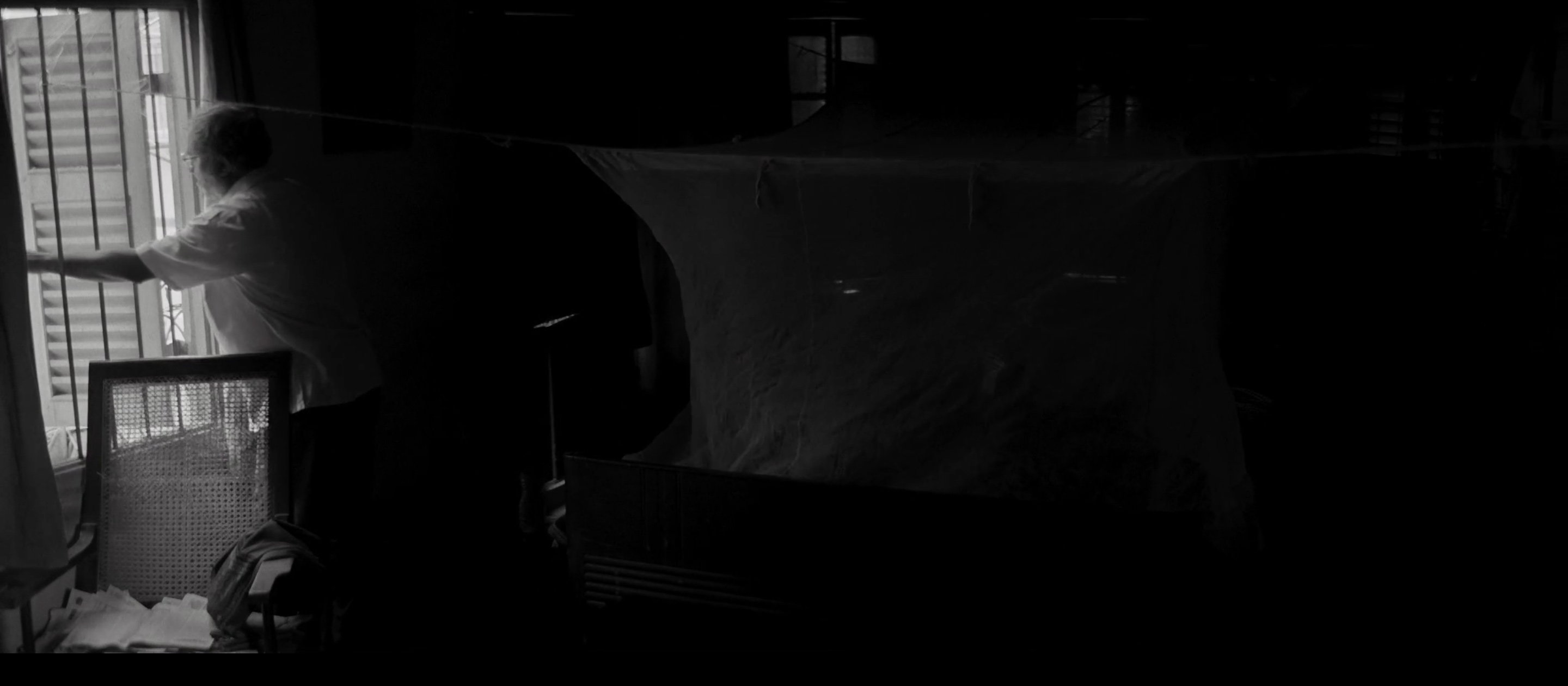
The film’s striking black-and-white aesthetic effectively captures the chaos and ugliness of urban life, serving as a visual metaphor for Manik’s internal struggles. The contrast is further heightened in the vibrant, colourful moments that bookend the film, highlighting the emotional awakening when isolation meets an unexpected connection. One of the most evocative scenes features Manik bathing in rainwater within the confines of his dilapidated bathroom, where the low-angle camera work and the sound of water create an intimate, almost tantric moment of union with the cloud. This scene resonates with the poetic essence of Tagore, reflecting the transcendence of mundane existence through a profound sensory experience.
While The Cloud and the Man treads familiar territory in its exploration of loneliness, it does so with a raw authenticity that breathes new life into these well-worn themes. The film invites comparisons to other cinematic works that have tackled isolation, yet it stands out with its unique, empathetic lens and richly detailed visual storytelling.
Though the film is not without its flaws—a tendency towards overused metaphors and moments where background music feels intrusive—the poignant character study and Banerjee’s ability to elicit empathy make it an engaging watch. The slow pace and cynical yet introspective musings like “My pastime is God” provide a reflective depth long after the credits roll.
In essence, The Cloud and the Man is more than just a film; it explores the human condition through the eyes of a solitary figure and his ethereal counterpart. Banerjee’s debut serves as a reminder of cinema’s power to illuminate the intricacies of isolation and connection, marking it as a noteworthy addition to the contemporary film landscape. If you’re seeking a thoughtful, artistic experience that merges the tangible with the intangible, this film is undoubtedly worth your time.
Director and ScreenplayAbhinandan Banerjee.
ProducerBauddhayan Mukherji, Monalisa MukherjiDoP Anup Sigh Editor Abhro Banerjee Art directorBablu Singh Sound designerAbhijit Roy Music directorSubhajit Mukherjee



 KINO PEAR