
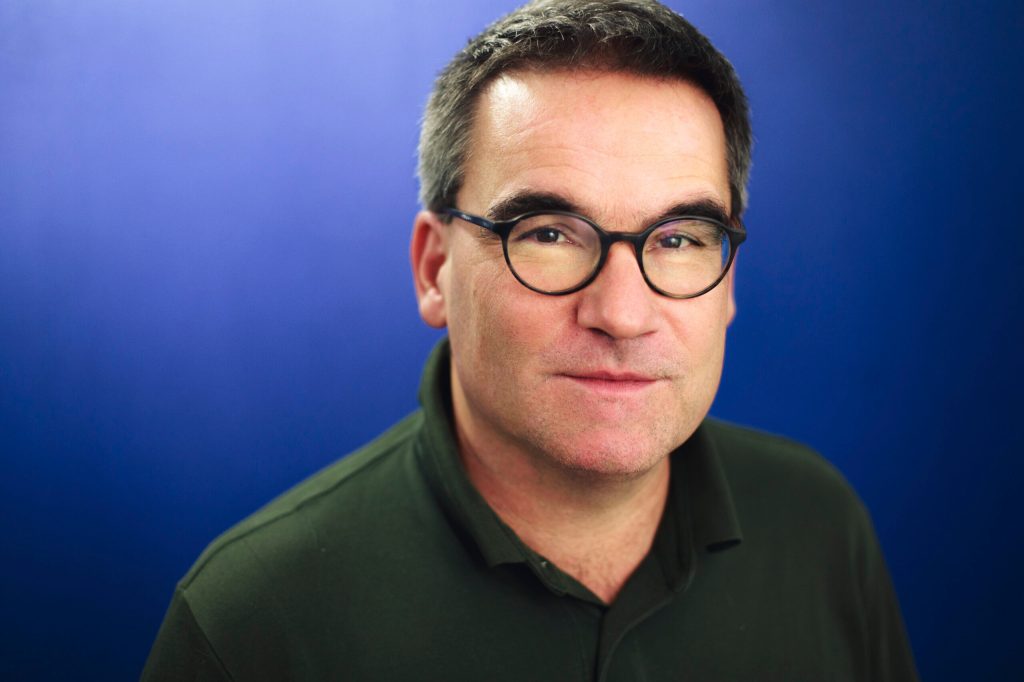
As FilmFestival Cottbus enters its 36th edition, Programme Director Bernd Buder reflects on the changing identity of Eastern European cinema, the importance of smaller festivals and why the best films leave us with something to think about.
By Milani Perera
What makes a film worth watching? For Bernd Buder, Programme Director of FilmFestival Cottbus, technical excellence alone is not enough. A film should surprise, challenge or move its audience in a way that stays with them long after the screening.
“I always appreciate films that ask more questions than they give answers.”
This belief lies at the heart of Buder’s approach to programming and FilmFestival Cottbus’s identity, founded in 1991 to explore cinema in the changing societies of Central and Eastern Europe.
Now celebrating its 36th edition, the festival continues to examine how filmmakers interpret political and social change while embracing the region’s increasingly diverse cinematic voices.
In conversation with Kinopear, Buder reflects on the changing nature of political cinema, the challenges of programming, the value of smaller festivals and what gives him hope for the next generation.
A Festival Built on Dialogue
Buder’s career began with political science rather than filmmaking. While studying in Berlin, he became interested in how cinema reflects history and society. His first film-industry job involved carrying 35mm prints at the Berlinale. He later joined Cottbus in various curatorial and communications roles and became Programme Director in 2015.
“My definition of politics is discourse and dialogue and moderation and not activism.”
For Buder, political films should encourage audiences to consider different perspectives rather than tell them what to think.
That philosophy is closely connected to Cottbus’s beginnings. Established shortly after German reunification, the festival sought to understand the transformations unfolding across Eastern Europe and what those experiences might reveal about eastern Germany’s future.
More than three decades later, Buder believes these stories remain relevant. Political uncertainty, changing institutions and historical upheavals continue to influence filmmakers across the region.
He also sees lessons in the resilience of societies that have lived through repeated transformations.
For him, cinema provides an opportunity to explore those experiences through observation and dialogue rather than political statements.
Rethinking Eastern European Cinema
Although Cottbus is associated with Eastern European cinema, Buder explains that this label oversimplifies a vast diversity.
“I think it does not really make sense. It’s a most simplifying term.”
The festival covers Central and Southeastern Europe, the Baltic states, the Caucasus and Central Asia, alongside neighbouring countries including Finland, Greece and Turkey.
These regions share parts of their histories, but their cultural identities and cinematic traditions differ considerably.
For Buder, Eastern Europe remains a convenient description rather than a single cinematic identity. Over time, Cottbus has expanded its perspective beyond the region’s socialist past to explore its broader historical, geographical and cultural connections.
He has also noticed changes in the films themselves.
Younger filmmakers are increasingly drawn to atmosphere, personal relationships and unconventional storytelling. At the same time, genre cinema, particularly horror, is becoming more prominent alongside established arthouse traditions.
Yet a distinctive approach to political storytelling remains.
Buder points to the region’s tradition of expressing political realities indirectly, shaped partly by the restrictions filmmakers faced under socialism. Rather than making explicit statements, they often explore social tensions through everyday relationships, ambiguity and dark humour.
Our conversation touched on the dark humour I have frequently encountered in Baltic cinema. Buder sees this sensibility across many societies shaped by historical upheaval, where humour becomes a way of confronting difficult realities.
For Cottbus, the purpose is not to define a single Eastern European identity, but to provide a space for these different cinematic voices.
The Art of Programming
Buder and his team consider approximately 700 to 800 films annually, including shorts, through submissions, festival visits and professional networks.
But selecting films is not simply a search for technical excellence.
He often encounters well-crafted productions with strong performances and convincing stories that nevertheless feel familiar.
“You have the feeling you have seen this film quite some times already.”
He is more interested in films that experiment with visual language, editing, sound or narrative structure.
Buder also feels a responsibility towards festival audiences. After investing their time, money and attention, viewers should leave with something worth thinking or talking about the following morning.
Yet even an excellent film may not find a place in the programme.
“Curating a programme means not only to select the best films, but it also means to arrange a composition of different works of art and films.”
A selection must work as a whole. A film may be admired by the programming team but rejected because it overlaps with other selections or does not fit the wider programme.
He also believes festivals should prioritise work that genuinely benefits from the big screen rather than films built around predictable television or streaming conventions.
The Value of Smaller Festivals
Cannes, Berlin and Venice offer international visibility that smaller festivals cannot easily match. Buder acknowledges that their premieres can influence future funding and careers.
But specialised festivals such as Cottbus offer something different: closer attention and lasting professional relationships.
At larger festivals, meetings are often arranged weeks in advance. At Cottbus, filmmakers and industry professionals can meet repeatedly, allowing conversations to develop naturally.
Some collaborations formed there have continued for years.
Buder recalls seeing the FilmFestival Cottbus laurels on a film poster at Poland’s Gdynia Film Festival. It was a small moment that made him proud because it showed that filmmakers valued the festival’s recognition.
For him, a festival’s influence is not measured only by prestige, but also by the opportunities and relationships it creates.
The Difficult Life After a Premiere
Even a successful festival screening does not guarantee a film’s future.
Buder has seen films fill festival theatres, only to attract a handful of viewers at regular cinema screenings days later.
It remains one of the industry’s most difficult problems.
“I still have no answer to this point,” he admits.
Festivals can maintain publicity, encourage repeat screenings and work with exhibitors. But distribution rights, commercial interests and limited resources restrict what they can achieve.
Cottbus has explored additional screenings and streaming opportunities, although Germany’s complex distribution market makes these difficult to organise.
At some point, Buder acknowledges, festivals must let films go.
The challenge raises a broader question about the festival ecosystem: how can films build meaningful audiences beyond the brief attention of a premiere?
Protecting Creative Risk
Buder also worries that financial pressures may discourage filmmakers from taking artistic risks.
He sometimes sees films with the potential to be more experimental or unconventional, yet their directors appear to hold back, perhaps concerned about funders, broadcasters or audience expectations.
“Sometimes I have the feeling those films could be much more interesting also for the audience if they would be more weird and more radical in terms of the artistic vision.”
He is not suggesting that every film should be experimental. Rather, filmmakers should have the confidence to develop their own cinematic language instead of relying on familiar forms.
For Buder, originality remains essential to keeping cinema alive and engaging.
Beyond Financing: Connecting Cottbus
That commitment to filmmakers extends to connecting Cottbus, the festival’s co-production market.
Buder sees its greatest value in the professional relationships it creates.
For many filmmakers, the market provides their first opportunity to present a developing project, receive honest feedback and meet potential collaborators.
Its relatively intimate environment encourages conversations that might be difficult at larger industry events.
Financial support is never guaranteed. Filmmakers may leave with interested partners who must still secure funding in their own countries.
Yet Buder estimates that approximately 65 per cent of projects presented at connecting cottbus have eventually been realised, an indication, in his view, of the market’s careful selection and professional relevance.
For him, the market is as much about building long-term partnerships as financing individual films.
Young Audiences and Cinema’s Future
Like many festivals, Cottbus faces the challenge of attracting younger audiences.
Buder believes the problem is not that young people lack the patience for complex cinema, but that festivals sometimes struggle to communicate with them.
He recalls a screening for around 100 teenagers of a quiet observational film set in a school in a Kurdish region of Turkey.
Despite its unconventional form, the students became completely absorbed.
He values their honesty. Young audiences are often willing to challenge filmmakers directly, without the professional politeness that sometimes shapes festival conversations.
The difficulty, he suggests, is making festivals feel accessible to a generation that may see them as formal cultural institutions.
As for young filmmakers, Buder remains optimistic.
He is excited by directors experimenting with editing, rhythm and storytelling structures that differ from those familiar to his generation.
Even after decades of programming, he still looks for the moment when a film draws him so completely into its world that he feels part of what is happening on screen.
That sense of discovery continues to define his relationship with cinema.
FilmFestival Cottbus began by looking towards societies undergoing profound change. Today, it continues to bring different histories, perspectives and artistic voices into conversation.
For Buder, the festival’s purpose is not merely to show films from a particular region, but to encourage curiosity, challenge familiar assumptions and create connections that endure beyond the screening.
A good film should leave its audience with new questions. Perhaps a good festival should do the same.




Leave a Reply