
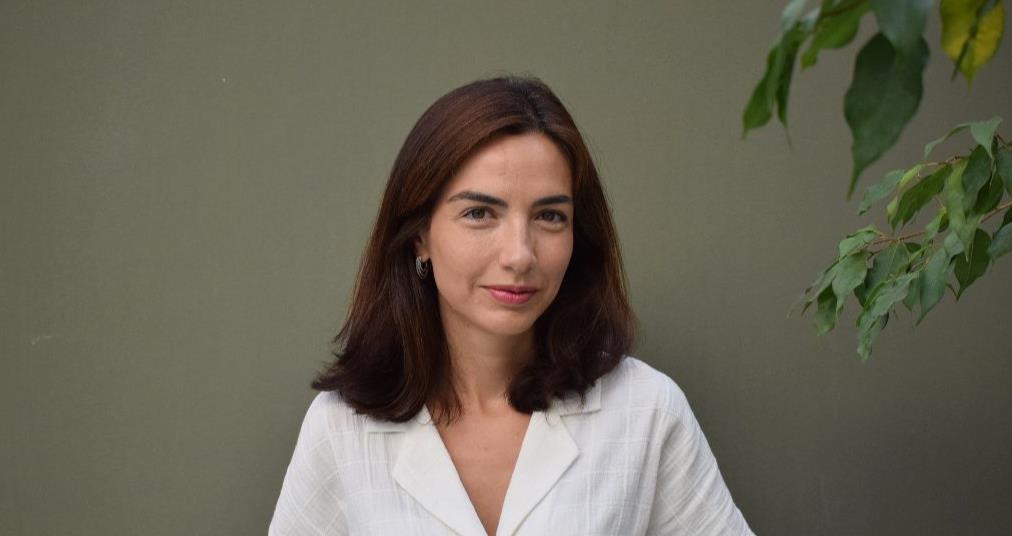
Tamara Tatishvili on risk, artistic freedom, and the fragility of development support
What allows a film to begin before the world has decided it matters? Before a script is stable, before co-producers arrive, before a festival slot or market trajectory confirms its value? In contemporary cinema, that early stage is one of the least visible, most precarious, and most decisive parts of the process. It is where projects are shaped, tested, translated, abandoned, reimagined, or quietly lost.
In conversation for Kinopear, Tamara Tatishvili, Head of the Hubert Bals Fund, speaks from within that vulnerable interval. What begins as a discussion about development support opens onto something larger: how early funding recognises artistic potential, shapes careers, and protects artistic freedom. What emerges is not simply a defence of funding, but a sharper proposition: that early support remains one of the few places in cinema where belief still has to operate without guarantees.
What sustains a film before it is visible?
Tatishvili’s authority on this question comes not only from her current role but from the conditions that shaped her. Raised in post-Soviet Georgia in the 1990s, she grew up in a country with a rich cultural legacy and fractured structures, where cinema remained close even when a future in film felt uncertain. She recalls being a devoted moviegoer and, just as importantly, being drawn to what stood behind the screen: the systems, collaborations, and mechanisms that allow films to come into being. “I always wanted to know what the mechanisms are behind the screen that allow films to come to life,” she says.
The line is revealing because it names the deeper logic of her work. Cinema, in her account, is not only an art of images and stories. It is also an art of conditions. It depends on structures that can nurture, delay, distort, or enable artistic work long before an audience sees the result. Her own path — from the South Caucasus into a career shaped by international collaboration, institution-building, and film support — explains why she speaks with unusual clarity about funding. She does not see it as a practical layer added to cinema from the outside, but as part of cinema’s inner architecture.
How does a fund recognise a film that does not yet fully exist?
This is where the conversation becomes especially useful for emerging filmmakers. What does a fund like the Hubert Bals Fund actually look for when a project is still in its earliest form?
Not Polish, Tatishvili insists. Not the false reassurance of a project that already looks complete. “We do not seek the polished, fully embedded script,” she says. “Because then it’s not an early stage of development, but artistic vision.” The distinction matters. At this level, a project is assessed not only for what it is, but for what it might become. The filmmaker must be able to articulate ambition, and there must be enough evidence — often through earlier short work or another cinematic sample — that the ambition can be carried through.
This requires more than script evaluation. It asks institutions to recognise potential without confusing potential with certainty. It also asks filmmakers to understand that early support is not about presenting a finished object, but about making a compelling case for why a project needs room to grow.
Why is development the hardest stage to support?
“Development funding is a risk funding,” Tatishvili says, in one of the conversation’s clearest lines. The force of that statement lies in its precision. Many public funds are more comfortable entering later, once a project has a clearer industrial shape. But the beginning is exactly when the filmmaker has the least protection and the greatest need.
Tatishvili speaks about this without romanticism. Filmmakers at the development stage are often trying to write, research, translate, or rethink a project while doing multiple other jobs simply to live. Time becomes fractured. Concentration becomes fragile. Even practical tasks — such as translating a script into English or French for international partners — require resources many filmmakers do not have. “You are a human being, whether you’re a filmmaker or not, and everyone needs to live,” she says. It is one of the simplest lines in the interview, and one of the most important.
The conversation becomes richer when she acknowledges that development is not merely the road to production. It is also the stage at which a filmmaker may realise that a project is not yet possible, or not possible in the form first imagined. A budget may be unrealistic. A team may be too fragile. A story may be too painful to carry into a finished work. Tatishvili speaks of projects that remain meaningful, even healing, but cannot become films under their current conditions. That honesty restores seriousness to the development phase. It is not simply a waiting room. It is where the project is tested against reality.
What can a grant change beyond the money itself?
This is perhaps the article’s central shift. Tatishvili is clear that a development grant will not solve production in any total sense. But she is equally clear that this is the wrong way to measure its value. “We see ourselves as facilitators and career impact providers for the filmmakers,” she says.
A grant, in her view, is not only an amount. It is also a signal. It can put a filmmaker on the radar of producers, minority co-producers, and institutions that follow HBF’s decisions. It can generate movement around a project before it is fully secure. Tatishvili describes producers “flying around” the fund’s decisions, following press releases and looking to pick up projects or enter co-production conversations. In that sense, the grant functions not only as support, but as recognition with consequences.
This is why the Hubert Bals Fund appears here not as a standalone grant-making body, but as part of a broader ecology. Tatishvili speaks about additional mechanisms through which HBF-backed projects can return in later forms, whether through other support routes or minority co-production frameworks. Officially, that ecology is now quite clear. HBF+Europe extends support beyond development through two linked schemes: Minority Co-production Support, aimed at European producers joining eligible international co-productions before production, and Post-production Support, designed for European minority co-productions already in post-production.
Alongside this, the long-running NFF+HBF Co-production Scheme allows Dutch producers to apply for production support of up to €75,000 when co-producing a project that previously received HBF Development Support. The picture has also widened geographically. HBF+Brazil: Co-development Support, launched with partners including RioFilme, Spcine, Projeto Paradiso, and later Embratur, is a dedicated early-development scheme for second- and third-time filmmakers from Brazil.
Taken together, these schemes make the fund’s role more precise. HBF is not only helping a film begin; it is helping build the conditions under which a project can continue, find partners, and enter the world with greater force. That is the deeper point of Tatishvili’s argument: early support matters not simply because it finances a stage, but because it changes the trajectory through which a film becomes visible.
When does support become career-making?
One of the most compelling dimensions of the interview is Tatishvili’s insistence that support is not only about individual films. It is also about trajectories. She repeatedly returns to career impact and to the need for institutions to think beyond a single decision. In this sense, the alumni dimension of HBF matters not because it creates prestige, but because it reveals how early trust can resonate across a longer artistic life.
Her example of Marcelo Gomes is especially striking. She recalls his saying that HBF development support gave him “the proof of confidence” that he should not question his ambition too early. That phrase deserves to linger. In emerging cinema, confidence is not sentimental. It is infrastructural. It can shape whether a filmmaker continues, deepens, risks more, or disappears under the weight of precarity and doubt.
Tatishvili also speaks about alumni such as Apichatpong Weerasethakul and Payal Kapadia in this spirit — not as names to decorate an institution, but as reminders that timely support can alter what becomes possible. The article is strongest here because it makes visible something audiences often encounter only in retrospect: the long life of a decision made when a filmmaker was still far from established.
Who gets seen, and who still remains peripheral?
Tatishvili does not romanticise selection. She is explicit about the harshness of the process. HBF development support receives hundreds, often more than a thousand applications. By the later stages, many projects already hold real potential. The task is no longer simply to identify whether value exists, but to decide where intervention can matter most.
Just as importantly, she rejects the idea that these are simple, purely individual judgments. The process is built through committees with different cultural and geographical backgrounds, through discussion, advocacy, disagreement, and the realities of selective funding. “Funding is selective,” she says. “You win, and you lose.” Yet the bluntness of that phrase is balanced by a more thoughtful institutional logic. Decisions are not only about artistic strength in the abstract. They are also about diversity, exposure, geography, collaborative potential, and impact.
This leads into one of the article’s most politically revealing sections. Tatishvili speaks openly about the need to look more actively toward regions that have long been eligible but historically underrepresented in outcomes — including, in recent priorities, African contexts, and in the near term, Southeast Europe, the South Caucasus, and Central Asia. She is careful to distinguish this from quota logic. The issue is not mechanical balancing. It is whether an institution is willing to examine the patterns it reproduces. If it does not, visibility will continue to cluster around those already more likely to be seen.
The article gains force here because it treats selection as a shaping of visibility rather than simply a ranking of merit.
What does artistic freedom require now?
The deepest urgency of the conversation lies in Tatishvili’s insistence that the fund’s mission has not changed, even as the world around it has. “The mission of our fund is intact,” she says. That mission is to support filmmakers in pursuing artistic work without restriction, particularly from territories where freedom of expression or basic production conditions are under visible pressure. But she is equally clear that while the mission remains stable, the forms of support cannot remain static. Times are different, she argues, and institutions have to rethink how to carry that mission forward without compromising the core.
This is where the conversation extends beyond funding into politics. Tatishvili situates the present moment within a world shaped by war, shrinking cultural budgets, harder ideological climates, and the continuing vulnerability of culture under authoritarian or increasingly restrictive conditions. For her, culture matters precisely because it moves. Late in the interview, she says, “Culture can travel without airplanes.” It is a memorable line because it explains, almost in passing, why culture is so often feared. It crosses borders, reaches people, unsettles them, and alters feeling and thought. It cannot be contained as neatly as policy may wish.
In that light, film funding is not only a practical support mechanism. It becomes part of a larger question: which voices are still able to move through the world?
Before the screen
What emerges from this conversation is larger than a portrait of one institution or one fund head. It is a clearer view of what meaningful support in cinema still tries to do: not simply finance projects, but create room for a voice to become audible; not simply distribute resources, but allow a fragile idea to hold its shape long enough to test itself against reality.
For emerging filmmakers, the relevance is immediate. The article clarifies what a fund like HBF is actually evaluating, why development is not a secondary phase of filmmaking, and how early support can create visibility far beyond the amount granted. For readers more broadly, it opens a side of cinema that often remains unseen: the moment before the screen, when time, translation, labour, feedback, and institutional courage determine which films are even allowed to begin.



Leave a Reply